|
 |
|
|
|
About Me - New Books for Young Readers - Books for Young Readers |
|
New Books for Young Readers |
|
|
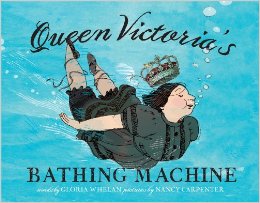
Queen Victoria's Bathing Machine | Prince Albert comes up with a royally creative solution to Queen Victoria’s modesty concerns in this true story that reveals an overlooked splash of history. Poor Queen Victoria! She loves to swim, but can’t quite figure out how to get to the water without her devoted subjects glimpsing her swimming suit. (Because, of course, such a sight would compromise her regal dignity.) Fortunately for the water-loving monarch, it’s Prince Albert to the rescue with an invention fit for a queen! This quirky tale about the longest reigning monarch in British history is as fun as it is authentic, and the book includes a picture of the actual bathing machine Prince Albert created. Queen Victoria is ready to break free from the constraints of life at the top (including literal ones, like corsets) and take a swim in the ocean. But that would never do given the mores of the era named after her—until her beloved husband Albert hits on a solution: a covered wooden cart with an undressing room that can be rolled into the sea, allowing the swimmer to discreetly enter the water. “No one will get so much as a peep,” Albert assures her, “except for the creatures down in the deep.” Whelan’s (Homeless Bird) rhyming bounds along with a crackle worthy of Gilbert and Sullivan, and Carpenter’s (Big Bear’s Big Boat) digital drawings are sublime. Her portrait of a loving marriage (which includes a scene of the Queen and Her Consort canoodling—in their nightgowns!) is every bit as wonderful as the busier scenes in which Albert (with assists from the couple’s many children) devises his contraption. But the finest image is the penultimate, which finds an ecstatic Victoria gliding through the lapis water in her swimming costume. |
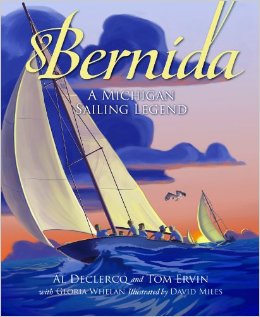
Bernida: A Michigan Sailing Legend | John, a young boy living on Michigan’s Mackinac Island, falls in love with sailing, and with an 87-year-old sailboat that in 1925 was the winner of the world famous Mackinac Island race. Lost and discarded for over 80 years the boat is re-discovered. It’s lovingly repaired and John has a hand in it. Against all odds the Bernida once again wins the Mackinac race and John is there to welcome the boat home. The wonderful part of the story is that there really is such a boat. Ages 5-8 |
In Andal's House | As a young boy in Gujarat, India, Kumar sometimes feels like he lives in two worlds. First, there is the old world: here people and their choices are determined by prejudice and bigotry, like that of his older sister who longs to go to design school, but instead must work in a factory. But then there is the second, modern world: in this world Kumar can be friends with whomever he chooses and his future looks bright and promising. As part of the annual Diwali celebration, Kumar is invited to the house of his classmate Andal, to watch fireworks. Andal is from a high-cast Brahmin family so Kumar is especially pleased to be included. But there in Andal’s house, Kumar’s two worlds collide in a very unpleasant way. Instead of being welcomed as a guest, Kumar is sent away, forbidden to join the festivities. Angry and hurt, Kumar is left questioning his place in Indian society. Where does he fit in? To which world does he really belong? |
All My Noble Dreams and Then What Happens | Set in India in the year 1921, two years after the events of Small Acts of Amazing Courage (2011), Whelan’s sequel finds British-born Rosy having returned to her beloved India, the land she considers home, after an extended stay in England. The household—now expanded to include Rosy’s maiden aunts, Ethyl and Louise—is bustling with preparations for a visit by the Prince of Wales. Rosy has promised to deliver a letter written by Mahatma Gandhi, an appeal to Great Britain to give India its freedom, and, once again, Rosy’s sympathies with native Indians lead to trouble with her stuffy father, a British officer. Using charm, wit, and intelligence, Rosy manages to draw compassion from her father and other authority figures, and she even gets the prince to recognize the poverty and unfair practices blighting India. As in the previous book, Whelan brings to life the customs, fashions, and conflicts of the era and creates a cast of vivid characters who represent multiple political views. Her writing provides great insight into a nation vibrating with changing attitudes. Gr 6-10 In this sequel to Small Acts of Amazing Courage (S & S, 2011), Whelan further develops Rosalind James's character and conscience. In 1921 British India, Rosy continues to find her voice as she grows in independence. She has spent her entire life in India, untraditionally making friends with Indians from different castes. She grows more sympathetic and outspoken regarding the complete dominance the British exert over the people. As a Gandhi supporter, she speaks out against her father, who insists that the country is not ready for independence. Through his military connections, Rosy meets the Prince of Wales on his tour of the country. With a little daring, she enables him to experience everyday India. After the adventure, he remembers Rosalind and sends an invitation to be presented to the king and queen of the British Empire. Could Rosalind be so bold as to bring the message of India's independence to the British sovereign? The character development and setting description are superb. Whelan succeeds in bringing a fascinating time period to life, allowing readers to experience the lavish luxury of the ruling British and the squalid poverty of average Indians. It is slightly contrived that Rosy would meet both prince and king in the casual way she does, but it serves the story well. The parallel between the young woman exerting her independence and India beginning to demand hers is a unifying element. This worthy sequel should enjoy wide readership where historical fiction is popular. A Best Bank Street Children's Book of the Year. |
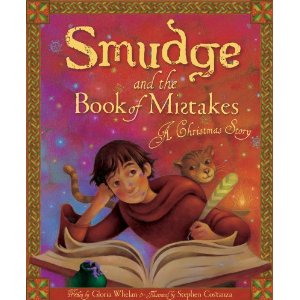 Smudge and the Book of Mistakes: A Christmas Story |
National Book Award–winner Whelan (Homeless Bird) writes a substantive story about the value of perseverance. It's set in a medieval monastery, where the hard-of-hearing and vainglorious abbot mistakenly appoints young "Smudge," so-called for his sloppiness and tendency to give up easily, to help Brother Gregory write and illuminate the Christmas story. Written with humor, empathy, and an eye toward human foibles, this story develops and resolves with charm, and its message goes down easy. Costanza (A Christmas Spider's Miracle) paints full-page interiors in deep hues of red, green, and purple that convey both the darkness of the monastery and the illumination within its inhabitants. All ages. Agent: Liza Pulitzer-Voges, Eden Street Literary. Illustrator's agent: Lori Nowicki, Painted Words. (Oct. '12) Publishers Weekly Starred review. Gr 2-5 A talented but easily frustrated young man is transformed by the encouragement and belief of the right mentor. Like many boys, Cuthbert is impatient, lacks discipline, and doesn't like making mistakes. After his annoyed father sends him to a monastery, he ends up in the scriptorium, where he earns the name "Smudge" for his poor skills. When he is mistakenly assigned to do the lettering for the Christmas story, everyone is sent into a tizzy except for master illuminator Brother Bede, who sees some talent in the boy and takes the time to encourage him to practice. Eventually the two create a masterpiece. Whelan's prose makes the long blocks of text flow like water and includes fun details (like the monks taking their yearly bath in preparation for Easter). Costanza's illustrations have the look and feel of animated movie art, which adds humor to what is essentially an apprenticeship tale. A lengthy read-aloud for parent/child sharing, but one that could be inspirational for the right listener. –Mara Alpert, |
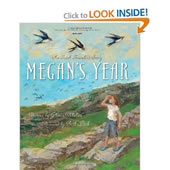 MEGAN’S YEAR |
A Tales of the World story of Ireland Megan spends her summers traveling around the Irish countryside with her family. They move from place to place, hauling their caravan (camper) behind their old car, never staying very long in any one location. But Megan and her family aren’t on vacation. This is their way of wife. Ten-year old Megan Brady enjoys summers the most because that season marks when she joins her four siblings and parents in their caravan as they travel across the Irish countryside in search of work. Their family belongs to the Irish Travelers, a group of about 25,000 ethnic Irish who have adopted their won language and traditions, including a lifestyle of migration that responds to work opportunities. -Yana V. Rodgers, |
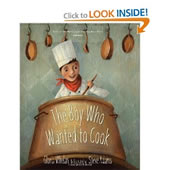
THE BOY WHO WANTED TO COOK |
La Bonne Vache (The Good Cow) is a little restaurant in the south of France. It takes its name from and is famous for its boeuf á la mode, a delicious beef stew. Ten-year-old Pierre longs to follow in the culinary footsteps of his father, Monsieur Valcourt. Monsieur Valcourt is the chef and owner of La Bonne Vache. Pierre spends as much times as possible in the restaurant’s kitchen hoping for a chance to demonstrate his cooking skills. But his parents shoo him away and tell him to spend time outdoors. He is not allowed to cook. “The Boy Who Wanted to Cook” is beautifully illustrated and can be read as an introduction to France and its food (there is even a glossary with a pronunciation guide at the back) or as the opening to a discussion of ethical behavior. Perfect for any young foodie. |
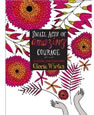
SMALL ACTS OF AMAZING COURAGE |
Master storyteller Whelan (Homeless Bird) again whisks readers to a dramatic period in world history, this time to post-WWI India, where Gandhi's unconventional methods of protest are causing a stir. Fifteen-year-old Rosy, the daughter of a major serving in the British Indian army, possesses a big heart, curiosity, and a strong sense of justice. Unfortunately, her strict father doesn't share these traits. When she takes enormous risks--saving an Indian infant sold to a villainous beggar and sneaking off with her friend, Lt. Max Nelson, to witness one of Gandhi's speeches--her father becomes enraged. Rosy is sent back to England to live with her austere Aunt Ethyl and Ethyl's bullied younger sister, Aunt Louise ("Aunt Louise clutched me to her as if she were drowning and I was a life preserver"). It doesn't take Rosy long to shake up her aunts' somber household with her bold notions regarding Indian liberation. Whelan's insight into history and her characters' minds make every moment of this saga believable. The open-ended finale will leave fans yearning for a second installment. While her British Army major father has been away in WWI, 15-year-old Rosalind has enjoyed her southeast Indian town, roaming the bazaar with her Indian friends rather than chatting with other Brits at the local club. Then her father returns, and she chafes against his strict colonial views. After she is caught listening to Gandhi at a rally, Rosalind's furious father ships her off to her English aunts where her free-thinking spirit once again shakes up the status quo....Set during a pivotal moment in Indian history, Whelan's vivid, episodic story explores the tension between doing what's right, rather than what's expected and the infinite complexities of colonialism. 2012 South Asia Book Award Honor Book |
SEE WHAT I SEE |
Kate Tapert sees the world around her in the paintings she admires. Yet one place she never sees her life is in the work of the famous and reclusive artist Dalton Quinn -- her father whom she hasn't seen or heard from in ten years. Kate's own dreams of becoming an artist look like they're on the verge of coming true when she's offered a scholarship to art school in Detroit. Kate is ready to leave home and immerse herself in art heaven! -- and the only thing she needs is a place to stay. Her father's house would be the perfect place, but when Kate shows up on his doorstep out of the blue, she has no idea what a life-altering decision that will turn out to be. “See What I See is an absolutely riveting and heartrending work of fiction. I read it in a single session. It contians numerous surprises and doesn’t shrink from the seriousness of its subject and from the wonderful integrity of its young heroine Kate” With clear and elegant prose, Whelan portrays a gradually developing and complex relationship built on guilt, curiosity, love and a passion for art. Kate's eloquent depictions of nature may well inspire readers to look more carefully and thoughtfully at the world around them, be it urban or rural. Although the plotline and sentence structure are accessible enough for middle-schoolers, the lyrical writing will hold the interest of older readers as well. Beautifully expressing adolescent uncertainties and yearnings, this intimate novel will draw readers who, like Kate, have big hearts and big dreams. |